
Research peptide
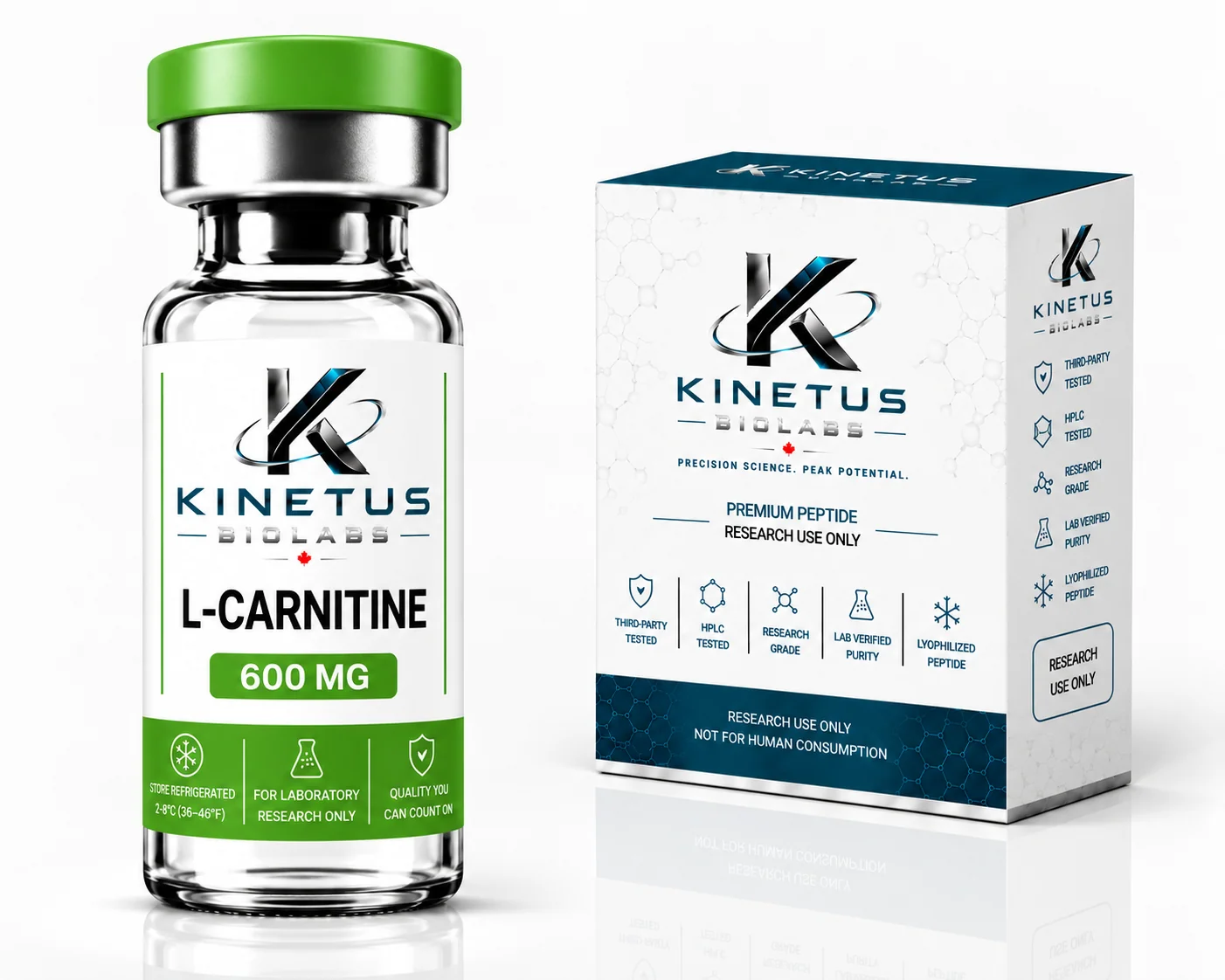
L-Carnitine
600 mg
Select size
$58.00CAD
Volume pricing
- Buy 2Save 5%$110.20 ($55.10 each)
- Buy 3Save 10%$156.60 ($52.20 each)
Applies to the total quantity in your cart.
Research material
Supplied in a sealed glass vial and labelled with a batch reference. Batch-specific documentation is available on request. For Research Use Only. Not for Human or Animal Use.

- Presentation
- 600 mg
- Container
- Sealed glass vial
- Batch reference
- Printed on every unit
- Documentation
- Batch-specific COA on request
- Research use
- For Research Use Only
Description
L-Carnitine is a naturally occurring quaternary ammonium compound that plays a central role in cellular energy metabolism. It functions primarily as a carrier that facilitates the transport of long-chain fatty acids into the mitochondrial matrix, where they can undergo β-oxidation and contribute to cellular energy production.
Because of its direct relationship with mitochondrial fatty-acid metabolism, L-Carnitine is widely studied in research involving energy production, metabolic flexibility, exercise physiology, and skeletal-muscle function. Research also examines its role in maintaining mitochondrial function under conditions of increased metabolic demand.
L-Carnitine exists in several biologically relevant forms, with L-carnitine representing the physiologically active stereoisomer. Beyond fatty-acid transport, carnitine biology is also connected to acetyl-group metabolism, mitochondrial homeostasis, oxidative metabolism, and cellular energy regulation.
Key Research Areas:
- Mitochondrial energy metabolism
- Fatty-acid transport and β-oxidation
- Exercise and muscle physiology
- Metabolic flexibility
- Mitochondrial function
- Cellular energy production
- Acetyl-CoA and acetyl-group metabolism
- Metabolic stress and recovery research
Why L-Carnitine?
L-Carnitine provides researchers with a well-characterized model for investigating the connection between fatty-acid availability, mitochondrial transport, and cellular energy production. Its role is particularly relevant in experimental models examining how cells and tissues adapt to changing energy demands.
Importantly, L-Carnitine is not a peptide or growth factor. It is an endogenous metabolic compound and an essential component of the carnitine shuttle that links fatty-acid metabolism with mitochondrial energy production.
At Kinetus Biolabs, L-Carnitine is positioned as a research-grade metabolic compound for investigating mitochondrial fatty-acid transport, energy metabolism, exercise physiology, and cellular metabolic function.
Kinetus Biolabs | Precision Science. Peak Potential.
Research Use Only — Not for Human Consumption.