

PRECISION SCIENCE. ANALYTICAL CONFIDENCE.
Research
The catalogue is grouped into research material categories. Choose a category to see the materials in it; a material can appear in more than one category.
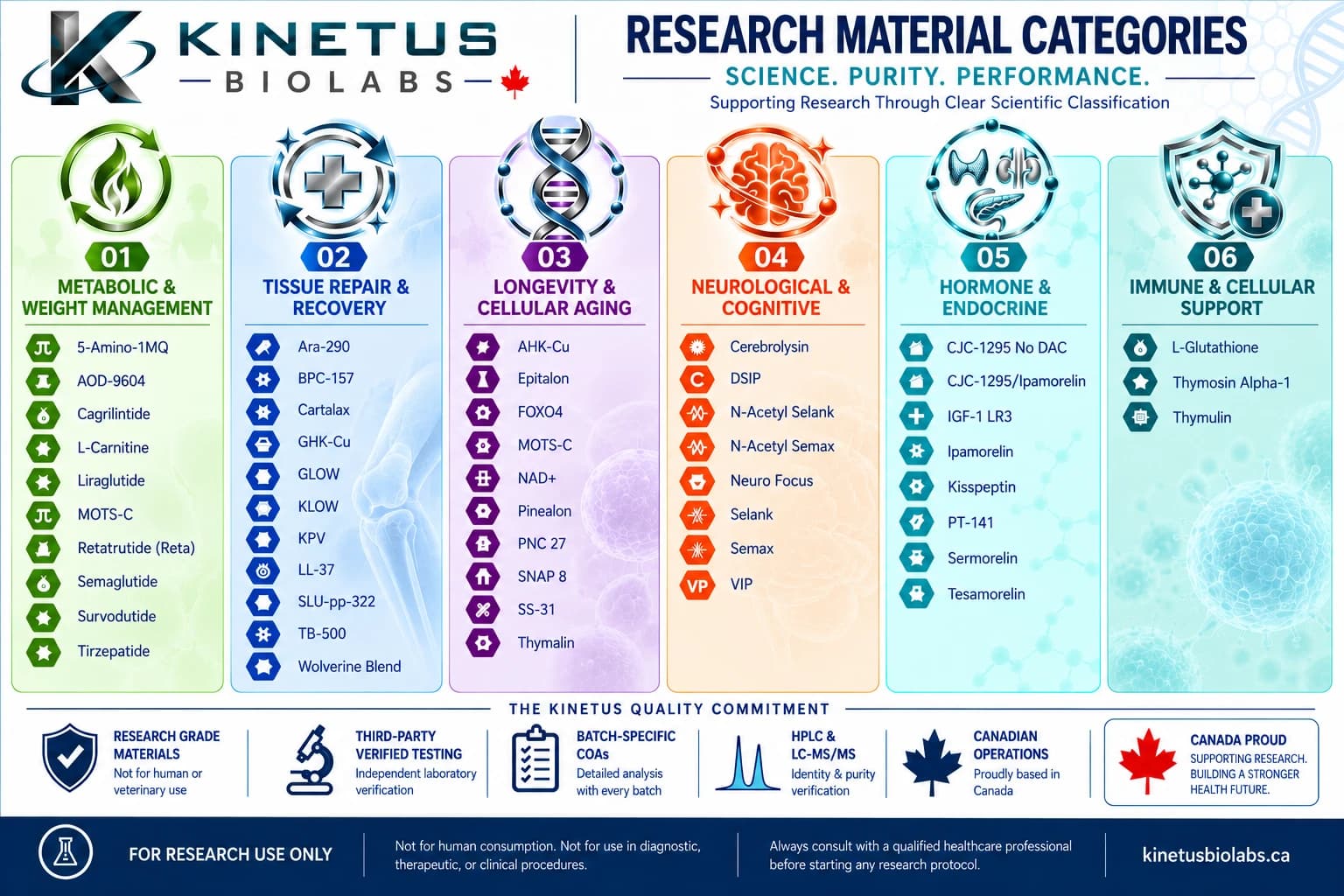
Research Classification Outline
 01Metabolic & Weight Management
| Research Material | Description |
|---|---|
| Retatrutide (GLP-3/Reta) | Investigated as a multi-receptor metabolic peptide targeting GLP-1, GIP, and glucagon pathways, with research focused on body weight, appetite regulation, glucose metabolism, and energy balance. |
| Semaglutide | A GLP-1 receptor agonist studied extensively for appetite regulation, glucose metabolism, and body-weight management. |
| Tirzepatide | A dual GIP/GLP-1 receptor agonist researched for metabolic regulation, appetite control, glucose homeostasis, and body composition. |
| Survodutide | An investigational dual GLP-1/glucagon receptor agonist being studied for weight management, metabolic health, and energy metabolism. |
| Cagrilintide | A long-acting amylin analogue investigated for appetite regulation, satiety, food intake, and body-weight research. |
| AOD-9604 | A modified fragment of human growth hormone investigated primarily for effects on lipid metabolism and fat-loss pathways. |
| Liraglutide | A GLP-1 receptor agonist studied for glucose regulation, appetite control, satiety, and metabolic research. |
| 5-Amino-1MQ | A small-molecule research compound investigated for NNMT inhibition and its potential effects on metabolic signaling, energy balance, and cellular metabolism. |
| MOTS-C | A mitochondrial-derived peptide being investigated for metabolic signaling, glucose utilization, mitochondrial function, and cellular energy regulation. |
 02Tissue Repair & Recovery
| Research Material | Description |
|---|---|
| BPC-157 | An experimental peptide extensively investigated in preclinical models for tissue repair, gastrointestinal function, angiogenesis, and inflammatory signaling. |
| TB-500 | A research peptide related to thymosin beta-4, investigated for cellular migration, tissue remodeling, angiogenesis, and recovery processes. |
| GHK-Cu | A copper-binding peptide studied for extracellular-matrix remodeling, collagen-related pathways, skin biology, wound research, and tissue regeneration. |
| KPV | A short peptide derived from α-MSH investigated for inflammatory signaling, immune modulation, and gastrointestinal research. |
| KLOW80 | A research formulation investigated within peptide and regenerative-research protocols involving tissue recovery and cellular signaling. |
| Wolverine Blend | A combination research formulation generally centered on BPC-157 and TB-500 research, designed to investigate complementary pathways associated with tissue repair and recovery. |
| LL-37 | A naturally occurring antimicrobial peptide investigated for innate immune signaling, antimicrobial activity, inflammation, and tissue-repair mechanisms. |
| GLOW-50 | A multi-component research formulation investigated for pathways associated with skin, connective tissue, recovery, and regenerative biology. |
| GLOW-70 | A higher-strength GLOW research formulation investigated across regenerative, tissue-support, and cellular-repair pathways. |
 03Longevity & Cellular Aging
| Research Material | Description |
|---|---|
| 5-Amino-1MQ | Investigated as an NNMT inhibitor with research interest in cellular metabolism, energy balance, adipose biology, and metabolic aging. |
| MOTS-C | A mitochondrial-derived peptide being studied for mitochondrial signaling, metabolic regulation, glucose utilization, and cellular stress responses. |
| Epitalon | An experimental tetrapeptide investigated in aging research, including cellular senescence, telomere-related biology, and circadian mechanisms. |
| NAD+ | A central cellular coenzyme involved in energy metabolism and redox reactions, extensively researched in relation to mitochondrial function, DNA repair, and cellular aging. |
| Pinealon | An experimental peptide studied in relation to cellular aging, gene-expression regulation, neurological biology, and longevity research. |
| SS-31 | A mitochondria-targeted peptide investigated for mitochondrial membrane integrity, oxidative stress, cellular energy production, and mitochondrial dysfunction. |
| Thymalin | A thymic peptide preparation investigated in immunological, aging, and cellular-regulation research. |
| FOXO4-DRI | An experimental peptide investigated for its ability to interfere with FOXO4-p53 signaling and selectively target senescent-cell biology. |
| AHK-Cu | A copper-binding peptide researched primarily for skin biology, extracellular-matrix remodeling, collagen-related pathways, and tissue regeneration. |
| Thymalin | An experimental thymic peptide preparation investigated in immune regulation, cellular aging, and age-related biological processes. |
 04Neurological & Cognitive
| Research Material | Description |
|---|---|
| Cerebrolysin | A neuropeptide-based preparation investigated for neuroprotective mechanisms, neuronal signaling, cognitive function, and recovery following neurological injury. |
| DSIP | Delta sleep-inducing peptide is an experimental neuropeptide studied in relation to sleep regulation, stress responses, and neurophysiological signaling. |
| Selank | A synthetic peptide analogue of tuftsin investigated for cognitive function, anxiety-related signaling, stress responses, and neuroprotection. |
| Semax | A synthetic ACTH(4–10) analogue investigated for cognitive function, neuroprotection, learning, memory, and neurological signaling. |
| Semax/Selank Blend | A research combination bringing together Semax and Selank pathways for investigation into cognition, focus, stress signaling, and neuroprotective mechanisms. |
| N-Acetyl Selank | A modified Selank research compound investigated for neurocognitive, stress-response, and neurological signaling pathways. |
| N-Acetyl Semax Amidate | A modified Semax analogue investigated for neurological signaling, cognitive function, neuroprotection, and related research applications. |
| PE-22-28 | An experimental neuropeptide investigated for neurotrophic signaling, neuronal survival, cognitive function, and neuroprotective mechanisms. |
 05Hormone & Endocrine
| Research Material | Description |
|---|---|
| CJC-1295 No DAC | A growth-hormone-releasing hormone analogue investigated for stimulation of endogenous growth-hormone signaling and endocrine research. |
| CJC-1295 With DAC | A long-acting GHRH analogue investigated for sustained growth-hormone and IGF-1 pathway activity. |
| Ipamorelin | A selective growth-hormone secretagogue investigated for stimulation of growth-hormone release while having relatively limited activity at other endocrine pathways. |
| Sermorelin | A GHRH analogue investigated for stimulating endogenous growth-hormone secretion and studying the GH/IGF-1 axis. |
| Tesamorelin | A GHRH analogue extensively studied for growth-hormone signaling, body-composition research, and visceral-adipose biology. |
| GHRP-2 | A growth-hormone-releasing peptide investigated for stimulation of GH secretion and regulation of the GH/IGF-1 axis. |
| GHRP-6 | A growth-hormone secretagogue studied for GH release and interactions with ghrelin-related endocrine pathways. |
| Hexarelin | A potent experimental growth-hormone secretagogue investigated for GH release, endocrine signaling, and cardiovascular research. |
| IGF-1 LR3 | A modified long-acting IGF-1 analogue investigated for cellular growth signaling, anabolic pathways, and metabolic research. |
| Kisspeptin | A naturally occurring neuropeptide investigated for regulation of the hypothalamic-pituitary-gonadal axis and reproductive hormone signaling. |
 06Immune & Cellular Support
| Research Material | Description |
|---|---|
| L-Glutathione | A major endogenous antioxidant investigated for redox balance, oxidative-stress pathways, cellular protection, and detoxification-related research. |
| Thymosin Alpha-1 | A thymic peptide extensively investigated for immune-system modulation, innate and adaptive immune signaling, and cellular immune responses. |
| Thymulin | A thymic hormone investigated for immune regulation, T-cell function, inflammatory signaling, and thymic biology. |
| LL-37 | An endogenous antimicrobial peptide investigated for innate immunity, antimicrobial activity, inflammatory signaling, and tissue-repair mechanisms. |
Research Material Categories
For Research Use Only. Not for Human or Animal Use.